

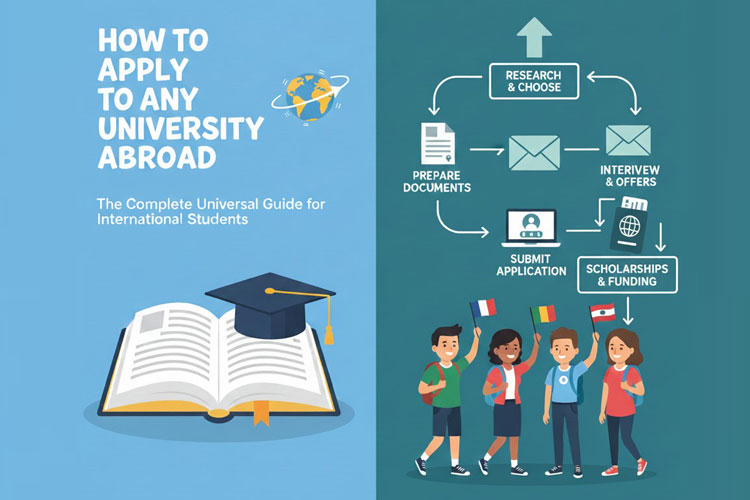
Studying abroad is an exciting opportunity, and the application process is easier than it may seem.
Although every country has its own rules, the core steps of applying to universities are almost identical worldwide — whether you choose Canada, the USA, Australia, the UK, or Europe.
This guide explains the universal application process that works for any country, any university, and any degree level (Bachelor, Master, or PhD).
🎓 1. Research Programs and Choose Your Destination
Every application starts with research.
The student must choose:
- The country
- The university
- The field of study
- The degree level (Bachelor / Master / PhD)
- The budget
- The language of instruction
- The application deadlines
This step is the same everywhere in the world.
📋 2. Check Academic and English Requirements
Before applying, all universities require two types of qualifications:
✔ Academic Requirements
This depends on the program:
- Bachelor: High school diploma + transcript
- Master: Bachelor’s degree in a relevant field
- PhD: Master’s degree + research proposal (usually)
Universities also require:
- translated documents
- notarized copies (sometimes)
- apostille/legalization (in some countries)
✔ English Language Requirements
All English-taught programs require proof of language ability:
Accepted tests include:
- IELTS Academic
- TOEFL iBT
- PTE Academic
- Duolingo English Test
- Cambridge Exams (CAE/CPE)
Scores vary, but the global standard is:
IELTS 6.0–6.5 or TOEFL 80–90+.
📄 3. Prepare Your Application Documents
Nearly every university worldwide asks for the same core documents.
These include:
Required Documents (Almost Everywhere):
- Valid passport
- Diploma + transcript of grades
- CV / Résumé
- Motivation Letter (Statement of Purpose)
- Recommendation Letters (1–2)
- English test results
- Portfolio (if applying to Art, Design, Architecture, IT, etc.)
If applying for a Master’s program, the student usually needs:
- academic CV
- bachelor’s thesis summary
- description of relevant experience
🖥️ 4. Submit Your Online Application
Applications are submitted through online platforms:
- University application portals
- National systems (UCAS in the UK, CommonApp in the USA, Studielink in the Netherlands)
- Third-party portals used by institutions
During this stage, the student:
- fills out forms
- uploads documents
- attaches the English test
- writes essays or SOP
- pays the application fee (if required)
Application fees vary from €20 to €150, depending on the university.
📬 5. Receive the Admission Decision (Offer Letter)
After the university reviews the application, it sends:
- Unconditional Offer — fully accepted
- Conditional Offer — accepted under conditions (e.g. send final diploma or English score)
- Rejection — if requirements are not met
The official acceptance document is often called:
- LOA (Letter of Acceptance) – Canada
- CAS (Confirmation of Acceptance for Studies) – UK
- Offer Letter – Australia & most of Europe
- I-20 Form – USA
This document is required for your student visa.
💳 6. Confirm Your Place (Deposit Payment)
To secure a place in the university, the student must:
- accept the offer
- pay the tuition deposit (usually €500–€5,000)
- receive a final acceptance confirmation
This step is standard in Canada, the UK, Australia, and Europe.
In Germany and some EU countries, deposits may not be required.
🛂 7. Apply for a Student Visa / Study Permit
This is one of the most important steps.
Every country requires similar documents, even though names differ.
Universal Visa Requirements:
- Passport
- Acceptance Letter (LOA / CAS / I-20 / Offer Letter)
- Proof of funds (bank statements showing you can support yourself)
- Medical insurance
- Visa application form
- Visa fee payment
- Biometric data (fingerprints)
- Evidence of accommodation (in many countries)
Some countries (Canada, Australia, New Zealand) require:
- medical examination
- police clearance (depending on country of origin)
Once approved, you get:
- Student Visa (USA)
- Study Permit (Canada)
- Student Route Visa (UK)
- Residence Permit for Studies (EU countries)
✈️ 8. Prepare for Travel and Accommodation
Before travelling, students usually must:
- pay first semester tuition
- book accommodation
- buy health insurance
- confirm arrival date
- book flights
- prepare finances for living costs
Many universities also provide airport pickup and a welcome package for international students.
🏫 9. Arrival, Registration, and Start of Studies
After arriving in the country, the student must:
- attend orientation week
- register at the university
- open a local bank account
- apply for a residence permit card (in the EU)
- activate student services
- choose courses
- begin academic life
This step is the same everywhere.
🌍 Conclusion: The Global Study Abroad Process Is More Similar Than You Think
Despite different rules, systems, and visa types, the overall study abroad process is almost identical in every country.
The universal steps are:
- Choose a country and program
- Check academic and English requirements
- Prepare documents
- Submit the application
- Receive an Offer Letter
- Pay a deposit
- Apply for a student visa
- Prepare for travel
- Begin your studies abroad